How Much Should I Feed My Cat? A Feeding Guide by Weight and Age
Most cats should be fed according to their daily calorie needs and the calorie density of their specific food, not a one-size-fits-all number of grams. The right amount depends on your cat’s ideal weight, age, activity level, body condition, and health status, as well as whether you’re feeding wet food, dry food, or a mix of both. A good starting point is the feeding guide on your food’s packaging, but that number should be adjusted based on your individual cat and confirmed with your veterinarian over time.
If you’ve ever stared at a bag of cat food trying to figure out whether the recommended amount actually applies to your cat, you’re not alone. Feeding guides are written for average cats, and your cat is not an average — they’re a specific weight, a specific age, and eating a specific food with its own calorie content. Below, we’ll break down exactly how to calculate the right amount for your cat, plus charts, schedules, and answers to the most common feeding questions.
How Much Food Should a Cat Eat Per Day?
The most common mistake in cat feeding is thinking in grams first. Grams are actually the last step. What really matters is calories.
Here’s why: two bags of dry cat food can look identical in size and weight but contain very different amounts of energy. One kibble might pack 4 kcal per gram, while a lower-density option might only have 3.2 kcal per gram. If you feed both foods “50 grams a day,” you’re giving your cat two very different amounts of energy. That’s how well-meaning owners end up with cats that are steadily gaining or losing weight despite “following the instructions.”
A cat’s daily food amount depends on several factors:
- Ideal body weight — not necessarily their current weight, especially if they need to lose or gain
- Age — kittens, adults, and seniors have different energy needs per pound of body weight
- Activity level — an active, outdoor cat burns more calories than an indoor cat that sleeps 18 hours a day
- Spay/neuter status — neutered cats typically need fewer calories than intact cats
- Body condition — an overweight cat needs less than the “standard” recommendation; an underweight cat needs more
- Health status — pregnancy, nursing, illness, and certain medical conditions change calorie needs significantly
- Calorie density of the food — this is what actually converts a calorie target into a real-world serving size
Once you know your cat’s daily calorie target, the formula for converting that into a usable portion is simple:
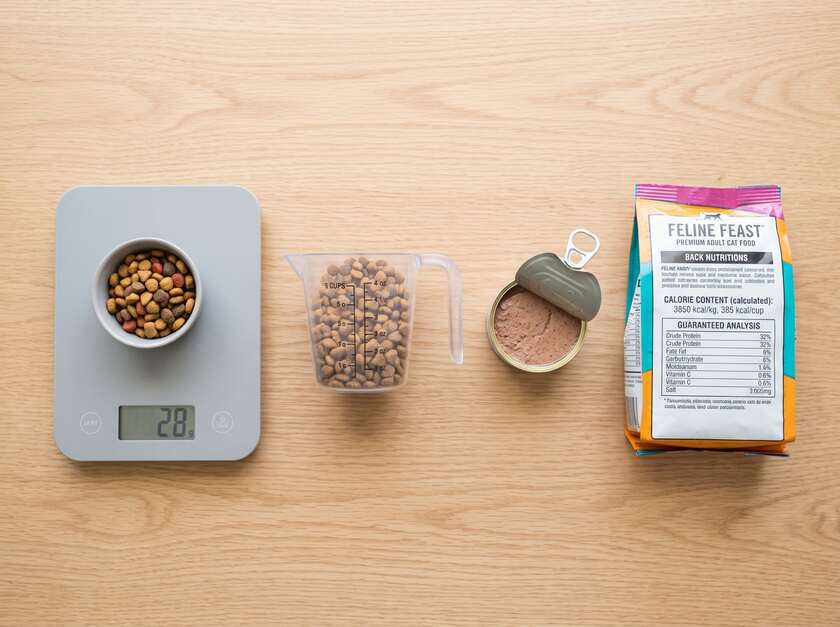
Food per day (grams) = Daily calorie target ÷ Calories per gram of food
For example, if your cat needs 220 kcal per day and the dry food contains 4 kcal per gram, you’d feed:
220 ÷ 4 = 55 grams per day
For wet food, the same logic applies, just measured in pouches or cans instead of grams:
Pouches or cans per day = Daily calorie target ÷ Calories per container
If a pouch contains 80 kcal and your cat needs 220 kcal per day:
220 ÷ 80 = 2.75 pouches per day
This calculation will always be more accurate than a generic “feed X grams” chart, because it accounts for the actual energy in the food you’re using.
Cat Feeding Guide by Weight
The chart below gives illustrative daily calorie ranges for healthy adult cats at an ideal body condition, along with what that might look like in dry or wet food. Treat these numbers as a starting estimate, not a prescription — your cat’s actual needs may fall outside these ranges depending on activity, metabolism, and health.
| Ideal Weight | Daily Calories (estimate) | Dry Food (4 kcal/g) | Wet Food (1 kcal/g) |
|---|---|---|---|
| 3 kg / 6.6 lb | 180–200 kcal | 45–50 g | 180–200 g |
| 4 kg / 8.8 lb | 200–240 kcal | 50–60 g | 200–240 g |
| 5 kg / 11 lb | 230–280 kcal | 58–70 g | 230–280 g |
| 6 kg / 13.2 lb | 260–320 kcal | 65–80 g | 260–320 g |
Always check your specific food’s label for its exact “kcal per cup,” “kcal per can,” or “kcal per kilogram” figure — this is the number you’ll plug into the formula above to get a portion size tailored to what you’re actually feeding.
How Much Should I Feed My Cat in Grams?
If you want a gram-based answer instead of guessing from a bag’s suggested serving, here’s how to find it yourself in two steps.
Step 1: Find the calorie content on the label. Most cat food packaging lists “metabolizable energy” or kcal per cup, per can, or per kilogram. If it’s not on the front, check the guaranteed analysis panel or the manufacturer’s website.
Step 2: Divide your cat’s daily calorie target by the calorie density.
Dry food example: A 4.5 kg adult cat with a daily target of 250 kcal, eating a dry food with 3.8 kcal per gram, would need:
250 ÷ 3.8 = ~66 grams per day
Wet food example: The same cat eating a wet food with 90 kcal per 85g can would need:
250 ÷ 90 = ~2.8 cans per day
This is a far more reliable method than trusting a single blanket number you saw online, because it’s built around your cat’s actual weight and your actual food.
Cat Feeding Chart by Age
Kittens
Kittens have high energy demands relative to their size because they’re growing rapidly. They need kitten-specific formulas, which are more calorie- and nutrient-dense than adult food, and they typically eat more frequent, smaller meals — often three to four times a day for young kittens. Always follow the calorie guidance on kitten food packaging, as it’s formulated differently from adult maintenance food.
Adult Cats
Once a cat reaches maturity (usually around 12 months), their energy needs stabilize, though they still vary by activity level and neuter status. Neutered adult cats generally require fewer calories than intact cats of the same weight. This is the life stage where the weight-based chart above applies most directly.
Senior Cats
Older cats (typically 7 years and up but especially over 11) can have shifting calorie needs in either direction — some senior cats need fewer calories due to reduced activity, while others, particularly those with conditions like hyperthyroidism, may need more despite losing weight. Senior cats also benefit from smaller, more frequent meals and closer monitoring of appetite and weight, since changes can signal underlying health issues.
Pregnant or Nursing Cats
Pregnant and nursing cats have substantially increased calorie needs — nursing cats in particular can require two to three times their normal maintenance calories to support milk production. This is a situation where feeding amounts should be guided directly by a veterinarian rather than general charts.
How Often Should I Feed My Cat?
| Life Stage | Suggested Frequency | Notes |
|---|---|---|
| Young kitten | 3–4 meals daily | Needs kitten food and frequent meals to support growth |
| Older kitten | 3 meals daily | Follow the kitten food’s calorie guidance |
| Healthy adult | At least 2 measured meals | Some cats do better with several smaller meals |
| Senior cat | 2–4 smaller meals | Monitor appetite, weight, dental health, and illness |
| Cat on a medical diet | As directed by a vet | Timing may depend on the condition or medication |
Meal frequency matters less than most people assume — what actually determines weight gain or loss is the total daily calories, not how they’re divided. That said, splitting food into multiple measured meals tends to produce better results than free-feeding, because it makes portion control and appetite monitoring far easier. Free-feeding (leaving food out all day) can work for some lean, active cats, but it’s generally not the best default, since it makes it hard to notice when a cat is over- or under-eating. If your schedule makes multiple meals difficult, an automatic feeder can help distribute measured portions throughout the day without you needing to be home.
How Often Should I Feed My Cat Wet Food?
The frequency of wet food meals matters less than the total daily amount. Whether you split a cat’s wet food allotment into two meals or four, what determines their weight and health is the total calories consumed across the day. That said, most owners feed wet food in two to three meals to keep it fresh, since wet food shouldn’t sit out at room temperature for extended periods.
Wet Food, Dry Food, or Both?
Wet food has real advantages, particularly for hydration — since it contains roughly 70–80% moisture, it supports overall water intake, which matters for urinary and kidney health. However, it still needs to be portioned by calories, not just “one can.” Opened wet food should be refrigerated, and uneaten portions shouldn’t be left out indefinitely.
Dry food is convenient, shelf-stable, and calorie-dense — but that density is also its biggest pitfall. A small-looking portion of kibble can contain a surprising number of calories, which is why weighing dry food in grams with a kitchen scale is far more precise than scooping a “cup.” Continually topping off a bowl without measuring is one of the most common causes of feline obesity.
Mixed feeding — combining wet and dry — is popular, but it requires one extra calculation step that owners often skip: subtracting the calories from wet food before calculating the dry portion.
For example, if a cat’s daily target is 220 kcal and their wet food provides 100 kcal, only 120 kcal remains to be covered by dry food. At 4 kcal per gram, that’s:
120 ÷ 4 = 30 grams of dry food
Skipping this subtraction step is a common reason mixed-fed cats gain weight — owners end up feeding a full “wet food serving” and a full “dry food serving” instead of splitting the daily total between the two.
How to Choose Healthy Cat Food
When selecting a food, look for:
- Complete and balanced nutrition — the food should state it meets AAFCO nutritional adequacy standards for your cat’s life stage
- Correct life stage — kitten, adult maintenance, or senior formulas are calibrated differently
- Clear calorie information — foods that clearly list kcal per cup, can, or kilogram make portioning much easier
- High-quality protein sources — cats are obligate carnivores and need diets built around animal protein
- Veterinary diets when appropriate — cats with medical conditions like kidney disease, diabetes, or urinary issues often need prescription formulas, which should only be fed under veterinary guidance
How to Tell Whether You’re Feeding Too Much or Too Little
Hunger alone is not a reliable way to judge whether you’re feeding the right amount — plenty of cats will act hungry even when they’re at a healthy weight or overweight. Instead, watch for:
- Weight trend over time — a gradual increase or decrease over weeks or months is more telling than day-to-day fluctuation
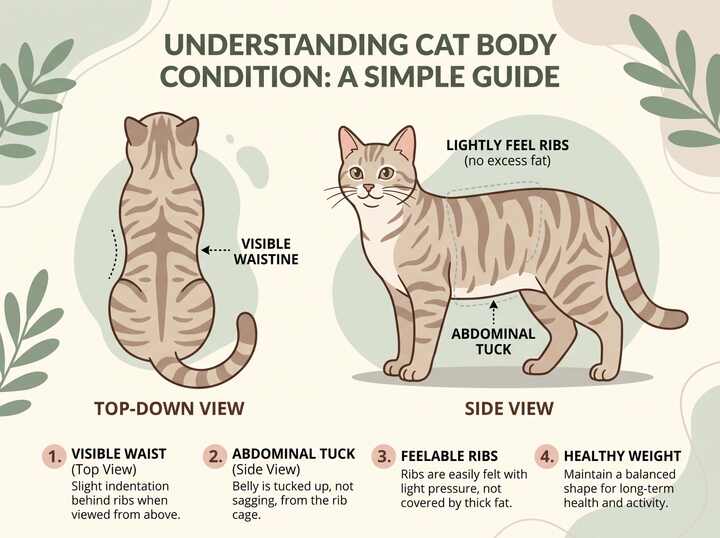
- Visible waist — when viewed from above, a cat at a healthy weight should have a visible waist behind the ribs
- Ability to feel ribs — you should be able to feel (though not necessarily see) the ribs with light pressure
- Body condition scoring — many vets use a 9-point body condition scale; ask your vet to score your cat at checkups so you have an objective baseline
If your cat consistently seems hungry but is at a healthy weight, the issue may be meal frequency or food type rather than total quantity — spreading the same daily calories across more meals, or choosing a higher-fiber or higher-protein food, can sometimes help with satiety.
When to Ask a Veterinarian
Reach out to your vet if you notice:
- Sudden changes in appetite (eating much more or much less than usual)
- Unexplained weight gain or loss
- You have a kitten and aren’t sure about growth-appropriate feeding amounts
- Your cat is pregnant or nursing
- Your cat is significantly overweight or underweight
- Your cat has been diagnosed with diabetes, kidney disease, or urinary issues
- Digestive problems like vomiting, diarrhea, or changes in stool
- You’re managing a cat on a prescription diet
A vet can calculate your cat’s specific calorie needs based on their exact weight, body condition, and health history — which is always more precise than any general chart.
Frequently Asked Questions
How much should I feed my cat per day?
It depends on your cat’s ideal weight, age, and the calorie density of their food, but most adult cats need roughly 200–300 kcal per day. Check your food’s label for kcal content and use that to calculate a precise portion.
How many grams of food should a cat eat?
This varies by food, since calorie density differs between brands. As a rough guide, a 4–5 kg cat eating a standard dry food (around 4 kcal/g) typically needs 50–70 grams per day.
How much should a 4 kg cat eat?
Roughly 200–240 kcal per day, which translates to about 50–60 grams of a typical dry food or 200–240 grams of wet food, depending on calorie density.
How much should a 5 kg cat eat?
Around 230–280 kcal per day, or approximately 58–70 grams of dry food or 230–280 grams of wet food.
How many times a day should I feed my cat?
At least two measured meals for adult cats, with kittens needing three to four and seniors often benefiting from smaller, more frequent meals.
How often should I feed my cat wet food?
Two to three times a day is common, though total daily calories matter more than the number of meals.
Is one can of wet food enough for a cat?
It depends on the can’s calorie content and your cat’s needs — some cats need more than one can per day, others less. Check the label’s kcal per can.
Can I feed my cat wet and dry food together?
Yes — just subtract the calories provided by wet food from your cat’s daily target before calculating the dry food portion, so you’re not overfeeding.
Is wet food better than dry food for cats?
Neither is inherently “better” for every cat — wet food supports hydration, while dry food is more convenient and calorie-dense. Many owners feed a mix.
Should cats have access to food all day?
Free-feeding can work for some lean, active cats, but measured meals generally make it easier to monitor intake and prevent weight gain.
How do I calculate wet and dry cat food portions?
Determine your cat’s daily calorie target, then divide by the calorie density of each food (kcal per gram for dry, kcal per can/pouch for wet), subtracting any overlap if mixing both.
How do I know whether my cat is overweight?
Check for a visible waist from above, feel for ribs under a light layer of fat, and track weight trends over time rather than relying on appearance alone.
Should indoor cats eat less?
Often yes — indoor cats tend to be less active than outdoor cats and may need fewer calories to maintain a healthy weight.
How much should a kitten eat?
Kittens need calorie-dense kitten food fed more frequently than adult cats — follow the feeding guide on the kitten food packaging, which accounts for their growth needs.
Why is my cat always hungry?
This can be due to the type of food, meal frequency, or underlying health issues like hyperthyroidism or diabetes — if persistent, it’s worth discussing with your veterinarian.
This article provides general educational information and is not a substitute for professional veterinary advice.